
 What is
with James Wan and dolls?
Putting
Billy in Saw was a stroke of
masterpiece, giving an otherwise not-TV-friendly film franchise a
mascot that was both highly recognizable and easy to use in all sort
of settings. Whether you consider it a good or a bad thing, it's
hard to argue that the Saw franchise
could have lasted for seven films if not for Billy's presence. The
role of puppets was just as important, if not more so, in Dead
Silence, where they played a
central role in the film. In Insidious,
a roomful of dolls existed entirely for creep factor in a single room
with no explanation.
In
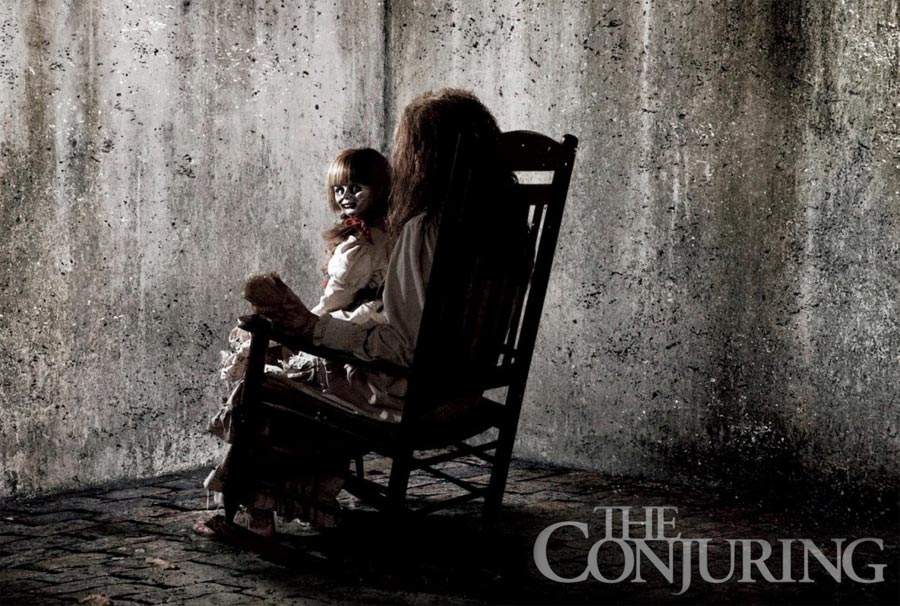
The Conjuring, a doll
features as well. This time, Annabelle is a doll possessed by a
demon that exists in a movie-within-the-movie. Technically, it's not
possessed, but for all intents and purposes, it is. To use the
language of the film, the Annabelle doll is a conduit through which a
demonic spirit enters the world.
It
is through this story that we meet two of our main characters, Ed and
Lorraine Warren. The couple exists in real life, and demonology were
their real careers. Save for how it influences the plot, I will not
be delving into their real lives, for several reasons. For the
purposes of this review, the characters in this film are fictional
adaptations of the Warrens the same way that characters in South
Park or Robot Chicken
would be – not that The Conjuring
treats them nearly the same way.
In
fact, much of The Conjuring
is slice of life, and here is where it might start to lose some
people. Fifteen minutes might go by of the Warrens and the Perrons –
the other family the film focuses on – going about their day to day
life. Then, something strange will happen. At least, that is the
perception. After all, a dog refusing to go into a house, or finding
a bruise on your leg, or seeing a known sleepwalker sleepwalk isn't
that strange, right? Then, maybe eight minutes of the same will pass
before something else strange happens. Then four minutes. Then two
minutes, or a minute. Then thirty seconds. Fifteen seconds. Eight
seconds. Suddenly four seconds later, we're in the movie proper.
If
Insidious was James
Wan's take on Poltergeist
– a strange haunting that takes the youngest child to another world
with a parent in pursuit – The Conjuring
is his take on The Exorcist.
I doubt this was intentional – the writing and production teams,
as well as the studio, are all different – but all of the elements
are there. It doesn't seem that way at first; rather, it seems as
though the house itself is haunted, despite there being hints at a
demonic possession tilt in the prologue. Still, the talk early on is
of demons and possession, and a lot of the scares and imagery are
modeled after The Exorcist.
On top of this is the religious tilt.
After
the slow buildup, this is the second place where the film may lose
some viewers. In order to follow the film, you must either believe
in, or suspend your disbelief of, Christianity. While the film does
not come down on the side of one religion, it does definitively state
that there is a powerful source of evil whose followers refer to it
as Satan. It also states that demons believe in Christianity enough
to be offended by its symbols as well as to go out of their way to
mock it, and that successful demon hunters are Christian and allied
with the Catholic church.
As
these elements are introduced, the Exorcism
parallels build steadily, up to and including an exorcism scene.
However, many of these elements are much larger. Rather than the
source of terror being a single, clear demon, the film begins with a
strange haunting by multiple spirits. After an investigation into
the matter, the source of these spirits is discovered, as well as
which is most dangerous, but that only escalates the danger they're
all in. I have to recognize the Hayes brothers here: they are fully
aware that they are writing for a savvy audience in the days of
Scream and Tvtropes.
In
fact, this is part of why the buildup takes so long. When the
audience expects one fake-out, the movie gives them two. When the
audience expects a jump scare, it either doesn't give one, or it
gives a small fake-out. When the audience expects to see a corpse,
we don't get one. “Don't go out there,” the savvy audience
member says, “something will kill you.” Then the character walks
out onto the pier, and nothing terrible happens. Nothing, that is,
other than finding something that works to her advantage later. This
does drag the movie out a bit, but it also makes the scares all the
more satisfying when they do come.
Which
brings us right back around to the doll. Annabelle is, in fact, a
huge fake-out. She exists in scenes primarily to build her up as one
of the most terrifying things the Warrens have ever seen. This works
well, largely because audiences have been bred over years to think
“doll” equals “scariest thing ever”. When dolls start doing
things you don't want to, it's either because they're going to
simultaneously molest and murder your child or because the thing
haunting your house is so scary that its very presence incites every
doll in the house to action. Or both.
The
Hayeses cash these years of built-up terror, plus their scenes of
building up their own doll, in one scene: a scene of someone holding
the doll, rocking on a rocking chair, while the doll turns its head
to look at someone. The scene continues from there, but that is the
end of Annabelle's participation as a threat, and it is brilliant.
Someone finally managed to do “build up the big, scary character
(or thing, in this case) and have it be completely outclassed just to
show how powerful someone else is” and have it work. In no way
does this scene make Annabelle look like a bitch, which allows the
doll to sit atop a throne made of Worf, Wolverine, Piccolo, Vegeta,
Rodan and countless others.
Another
thing that really helps this film is that the male leads are easily
distinguished from one another. I generally have a lot of trouble
telling multiple leads apart, particularly in a film where eleven
characters share much of the screen-time evenly. The females are
pretty simple to tell apart: generic very young girl, slightly older
girl who is usually afraid, older girl who wears glasses, and even
older girl who acts like, well, a teenaged girl who has just been
moved out of her home, and the two adult women who are almost always
in the company of their husbands. As for the men, we have
traditionally attractive white male (the hero), traditionally
attractive white male with a porn 'stache and sideburns, younger
Asian male, and a white male who doesn't look like any of them. I
wouldn't be able to pick Ron Livingston as he looks in this film out
of a crowd, particularly in 1971, but he definitely stands out
against the three I described. Altogether this is brilliant, or at
least something that is frequently overlooked that James Wan did not
ignore here at all.
The
Conjuring is not a film for
everyone. However, if you are still reading, you are aware of the
two main caveats and the only things I think will really fit into
deciding whether not to watch the movie. It fits right alongside
recent films that I greatly enjoyed such as Insidious
and The Woman in Black,
and is probably smarter than either of them. If you like horror,
particularly haunting and possession films, you don't want to pass
this up on the big screen.


 by Elliott James

 by Jaime Lee Moyer

 by Django Wexler
 by Ken Scholes
 by Davide Longo
 by Kat Falls
 by Elizabeth Richards
 by Adam McOmber
 by William E. Harlan
 by Marvin Amazon
 by Francis Knight
 by Frank Schatzing
 by Brandon Mull
 by Sarwat Chadda


 by Sam Cabot
 by V.E. Schwab
 by Ofir Touche Gafla
 by K.W. Jeter
 by David Drake
 by Kat Richardson
 by Wolfgang Jeschke
 by Larry Niven and Matthew Joseph Harrington
 by Sam Fisher
 by Matthew J. Kirby
 by Anthony Ryan