


An Unearthly Podcast: The Time Machine
We finally reach the end of Destiny of the Doctor! Does it meet expectations?
Red Ribbon Reviewers

An Unearthly Podcast: Death's Deal
The Unearthly Podcast crew continues our look at Big Finish's Destiny of the Doctor
series. Can Big Finish do my favorite Doctor justice?
Some NSFW language may occur.
An Unearthly Podcast: Night of the Whisper
The Unearthly Podcast crew continues our look at Big Finish's Destiny of the Doctor
series. The Ninth Doctor finally returns, with two of his most popular companions!
Some NSFW language may occur.
An Unearthly Podcast: Enemy Aliens
The Unearthly Podcast crew continues our look at Big Finish's Destiny of the Doctor
series. How is Destiny going to be faithful to the 8th Doctor's season? Perhaps it will be a movie on Fox...
Some NSFW language may occur.
An Unearthly Podcast: Light at the End feat. Night of the Doctor
We take a break from Destiny of the Doctor to celebrate the 50th anniversary of Doctor Who, with all eight Doctors of the classic era. But first, the TV series refuses to be outdone, finally giving the classic era closure of its own!
Some NSFW language may occur.
An Unearthly Podcast: Shockwave
The Unearthly Podcast crew continues our look at Big Finish's Destiny of the Doctor
series. My favorite classic Doctor and companion are here!
Some NSFW language may occur.
Book Catharsis: An Artificial Night by Seanan McGuire
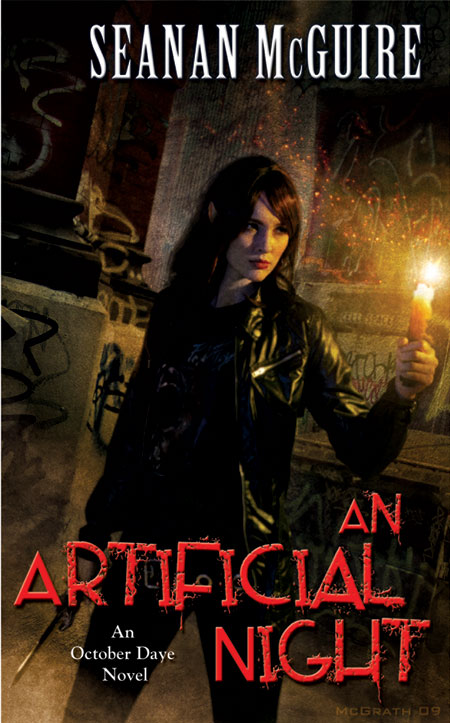
It’s difficult to start off a review of An Artificial Night, because it was nothing that I expected, and everything that I needed. An Artificial Night is the third novel in the October Daye series by Seanan McGuire. The first book, Rosemary and Rue, introduces the universe and the character, while taking the readers on an insane ride and a great mystery. The second book, A Local Habitation, continues the story, advancing the characters and giving a somewhat less compelling mystery. I expected An Artificial Night to be somewhere along the lines of Rosemary and Rue, rebounding from what I’ve heard described as the weakest book in the series to bring on a long-term series. Instead, what I got was pure catharsis.
There are those times in your life when you’ve got to be a big shot, don’t you? You’ve got to open up your mouth. Toby had to be a big shot, didn’t she, and her friends were so knocked out. She had to have the last laugh that night; she knew what everything’s about. She had to have a white hot spotlight. She had to be a big shot last night.
I’m fairly certain that Billy Joel meant that with a negative connotation, while this is what I love about An Artificial Night. Everybody sometimes needs to kick a bully in the teeth and punch him in the kidneys, and that’s what An Artificial Night is about. It’s not a mystery. There are questions, but that’s not the point of the story. The fact that there are more sequels to this implies that October survives, so I hope I’m not spoiling much when I say that Toby accomplishes just that. The question isn’t who is the bad guy or whether Toby is going to beat him, it’s what the hell Toby is going to do and how she’s going to get out of this.
Every moment was glorious. Toby is already an extremely cathartic character. She is a girl whose mixed blood causes her to be initially seen as less than nothing to those that she interacts with, yet this never causes her to still her tongue or her hand. She earned her way to knighthood, it was damned hard, and there is no way she’s going to let anyone talk down to her. Just to add to this, An Artificial Night introduces a conflict that is essentially that of a satyr reaching up and punching Zeus in the nose for being a dick - and then doing it again because the message didn’t stick.
An Artificial Night is really one of those stories that should be experienced, rather than explained, but even more than that it should really be experienced when you’re in a foul mood and could use something to bring you back. Anybody who has ever been bullied, or been out of reach and unable to stop a bully, or witnessed a bully, or known of a bully, can’t help but to love Toby as she goes above and beyond and says “I don’t care if I am an ant standing up to an anteater, this ends here” (that’s not a quote, unfortunately).
I would gladly say that this story stands on its own, but it is also a part of the mythos, and should still be regarded as such. I don’t know enough about the series yet to say that it must be read in order, but it certainly ought to be read after A Local Habitation, which in turn is best read by somebody who has already read Rosemary and Rue. This is an expanding universe, one that is taking on new characters and mythical elements with each story, so this is to be expected. Ultimately, this is a double-edged sword: while I am glad that it appeals to me even more as a sequel to books that I’ve already enjoyed, I am disheartened to think that there might be circumstances in which it is out of place for someone picking it up to read it. Maybe that’s just another reason for somebody who’s never read Rosemary and Rue to pick it up: when you never know when you’re just going to have to read An Artificial Night and need some background for it.
An Unearthly Podcast: Trouble in Paradise
The Unearthly Podcast crew continues our look at Big Finish's Destiny of the Doctor series. Will a series known for being faithful to the era it's imitating faithfully imitate an era known for being the downfall of the classic series?
Some NSFW language may occur.
Book Review: Speaker for the Dead by Orson Scott Card
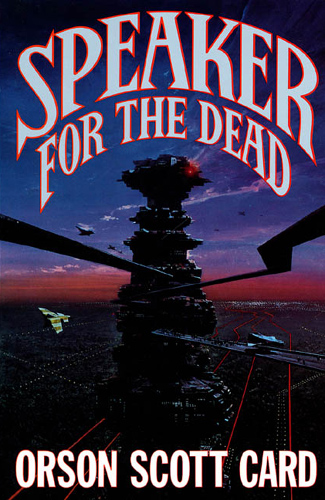
Speaker for the Dead was published by Tor Books in March of 1986. It had one prequel, the novel adaptation of Ender’s Game, originally published as an independent novella. All three were written by Orson Scott Card, and by the time the two novels were written the third, Xenocide, was on the way. Speaker for the Dead won the Nebula Award in 1986 and the Hugo Award in 1987 and starred Ender Wiggin, the star of Ender’s Game.
I’d find it refreshing to continue in this vein, and simply speak the truth about the novel, but I’m either not talented enough to do this book justice in that manner, or it’s simply not the way for me to go about this. That might be true for yet another reason: the Ender series isn’t dead.
Speaker for the Dead was conceived independently of Ender’s Game, and it shows, because the two novels are completely different. Ender Wiggin is the connecting factor, and he’s a big one; as literally both the head and the heart of the novels, his mind and methods are an important piece of why both novels succeed. Ender Wiggin is, at the core of his person, a genius, from the same ilk that spawned a man who hid his identity until after he had taken the world. Other than the fact that both Ender and his sister have continued publishing works under their assumed identities for a thousand years in real-time (accounting for the effects of thousands of light-years of travel at relativistic speeds), that’s stopped being relevant long ago. What’s important is that he’s assertive and compassionate, with all of the people skills learned by a lifetime of officer training condensed into a single childhood, and all of the empathy that made him worthy of all of that training. Add that to the fact that he’s become close friends with an AI that acts as this universe’s version of the Force, and Ender Wiggin may just be able to solve any problem that’s thrown at him.
But Ender’s a hero, and he’s survived his trials. Of course we root for him, but what’s truly powerful about this writing is the people who were never intended to be heroes. When someone like Ender Wiggin or Luke Skywalker, or Odysseus goes through trials, it’s okay. We grieve with them, we emphasize them, but ultimately as an audience, we’re cheering for them. Because we know that they have a destiny, that all of this pain is going to serve a purpose, and they’re being prepared to save somebody. But when regular people, with no special training and no special future, go through the same trials and have nothing in return for it, that’s when it really hurts.
That’s the thing about Fiction, really. People who decry Fiction for being too dark and people who hate escapism are both missing the point. Fiction allows a reader to experience things, powerful things, without facing the consequences themselves. It’s about emotional highs and lows as much as it’s about anything else. It allows you to experience incredible pain and sadness and anger and relief and acceptance all in a short time, without requiring you to live through the physical or emotional abuse of a lifetime first. It’s the rush of a race without the risk of impending crash, but in the hands of a dedicated writer, it becomes so much more than that too, because you’re meeting real people, and helping them through their trials just by bearing witness. And that, more than anything else, is what Speaker for the Dead is about. Feeling, without being devastated. Speculating without the consequences of acting on mistakes.
Not that everything is quite so straight-forward as the power of Fiction. In order to make this a true world, a real world with people living in it, Card by necessity made this a more complicated book. After all, a military organization- any military organization- is simpler than a town with a belief structure. That’s a large part of the function of the military: to keep everything in the social and power structure as simple and easy to follow in order to eliminate distractions. On Lusitania you have three competing power structures: the political, the religious, and the intellectual. In order to subvert the trope of characters from other worlds always having short, simple to pronounce names, the colonials speak Portuguese, each having long, over-blown names in addition to a shorter nickname for the audience.
The Catholic Church is a major player in this novel, which might be a problem for some readers. As somebody who both disagrees with certain aspects of the church in very strong ways and somebody who came into the novel with certain notions about how I expected the author to handle religion, I struggled with certain scenes. Early on, the portrayal of the church seemed to alternate between it being a villainous organization and the right way to live. Ultimately, though, this book doesn’t come out with a lot to definitively say about the church. The Catholic religion functions exactly as it does, one individual is shown to be pompous and overbearing in the beginning and to have a more open mind toward the end, and the church is portrayed as having the exact amount of power that it would have on a monotheologic colony twenty light years from the nearest other human settlement. Much like a speaking for the dead, this novel portrays the good along with the bad as part of a more complete truth, and doesn’t cram any belief or intent down the reader’s throat.
Speaker for the Dead is a story about the hard knocks of life. Through the veneer of Science Fiction and the suspense of interspecies relations, Orson Scott Card writes about dealing with terrible things, and about how good intentions lead several families through misery that might take several generations to work itself out. It’s also about more mundane miseries, such as the pain you feel when somebody shows affection that you’re used to seeing reserved for yourself to someone else in your stead. This is balanced out by the xenobiology and anthropology featured in the novel, which makes for some fascinating philosophical debates and great mysteries for the scientific-minded to work out, making this a great book for anybody who desires full immersion in a novel that pulls very few punches and demands you to read with both your mind, and your soul.
An Unearthly Podcast: Smoke and Mirrors
The Unearthly Podcast crew continues our look at Big Finish's Destiny of the Doctor series, this time with an unexpected guest that every Doctor Who fan will be familiar with!
Some NSFW language may occur.
Book Review: Ender's Game by Orson Scott Card

Orson Scott Card’s Ender’s Game might well be the most beloved prequel in all of literature. Not all versions of the story are the prequel, and it wasn’t released that way, but if not for Speaker of the Dead, the novel form of Ender’s Game that so many of us grew up with would never have come to be.
Ender’s Game tells the story of the Wiggins siblings, Andrew (nicknamed “Ender”), Peter and Valentine. The story’s not told from Peter’s perspective- it would be difficult to keep the “innocence under duress” tone of the novel if it featured viewpoints of a true sociopath- but there are a good deal of passages of Valentine and Peter working together or at odds. This is told largely independently of the story of their brother, the titular Ender, but Valentine plays a key role in Ender’s development.
An ironic side effect of reading this book with my particular tastes is the psuedo-incestual vibe this book starts to give off. That might be slightly disturbing if you don’t know what I’m talking about from having read my past reviews, but that’s okay, because that just makes it more funny. What’s ironic is that picturing a devout religious individual with certain very traditional values regarding religion writing something with an unintentional incest vibe is just funny to me. And of course, what’s “psuedo” is the fact that Ender probably hasn’t gone through puberty by the time the book ends, and it’s only his precocious nature that allows an older reader to see his tendencies as anything other than child-like innocence.
Now that I’ve made everybody thoroughly uncomfortable, what is it that elevates this book to such a status, despite the fact that the entirely series has an obvious “written during the heart of the Cold War” vibe? Maybe it’s the way a “children can save the world” story is told in a way that adults can still find believable and interesting. It could be the way the aspects of the Hero’s Journey are exaggerated to their most powerful extent, with all of the emotion behind it of a bare child. Maybe it’s the way a good person could do ethically questionable things in a completely un-questionably ethical way.
All of these elements are present in Ender’s Game, not to mention a twist at the end that makes me hesitant to even discuss the plot for fear of first-time readers seeing this. There’s a host of characters, with the biggest flaw of the book being that few of the characters are given enough personality to be memorable down the line. You want to learn more about them, but the story is about Ender. One of the more mysterious players, an even younger boy nicknamed “Bean”, gets his own series of novels, and my only hope is that some of these side characters get their real moments to shine (and aren’t revealed to have been burnt up in their childhood) in these books.
Ender’s Game is a book that any Science Fiction fan should read- particularly young ones who can handle death in fiction but are still learning their way around the genre. It’s not hard Sci-Fi, not because it’s Fantasy, but because the writer felt that the book should be easy for everybody to understand. I personally wouldn’t have minded an extra 1% or so to harden the science, but I can definitely agree that it wouldn’t have been as accessible to me at twelve years old if that were the case. And that’s the point- the accessibility of this book is what catapulted Ender to the forefront of the young adult genre. But it’s not the only reason to read it.
And, for the record, I’m not qualified to comment on Card’s life outside of his fiction work, but if you feel you are, this book is crazy easy to find used, so don’t let politics get in the way of enjoying and learning from this piece.
An Unearthly Podcast: The Day of the Doctor
For those who don't follow us via other channels, on November 24th, the Unearthly Podcast crew discussed the Doctor Who 50th anniversary special: The Day of the Doctor.
My Thoughts About Ender's Game: How Much Thought Went Into It?

I really would have liked a second
opportunity to watch Ender's Game
before writing about it. In all honesty, I can't consider this a
review. I'm of mixed mind on a lot of things, which is why even this
took so long to write. That, and the fact that November kept my nose
to the grindstone, as it were.
What
is Ender's Game, then?
Well, for one, it's a film that a lot of people were really
interested in seeing. I imagine many schoolchildren were first
introduced to Science Fiction by Orson Scott Card. Now, years later
for me and decades later for this story, it's on film. Ender's
Game was a very cerebral novel,
largely taking place in Ender's head, gauging his reactions as he
transformed from a boy with potential to a leader with no choice to
do anything but.
Writer/Director Gavin Hood's
biggest project prior to this was X-Men Origins: Wolverine,
a film that, to put it lightly, was not well received. How did this
influence his approach to Ender's Game?
Well, it seems that Hood was inspired to transform Ender's
Game into...a music video.
No,
this isn't a movie in the manner of Moonwalker
or Heavy Metal. It
wears the facade of a regular movie. But it was written like the
skit segments of a music video. It had the same feeling of
compression, the same depth of plot and character, as a music video.
It had the same strange, semi-symbolic-but-mostly-just-surreal
imagery as a music video. And it had just the sort of long,
drawn-out sequences of walking down a corridor as strange things
change for no reason that made me expect David Bowie to step on
screen and start twirling his balls...ball. Whatever.
It
is clear that Gavin Hood understood a lot of the plot elements that
made Ender's Game
work. It is just as clear that he either didn't understand why
they worked, or he didn't understand how to adapt it into a cohesive
movie that still worked. Instead, we get a jumble of plot points
thrown at us like a game of plot-point dodgeball, with all of the
time that made them work skipped over. We get lingering scenes of
the highest paid actor in Hollywood earning his paycheck by talking
about what Ender should be doing, which results in his entire
schooling seeming to take less than a week, rather than the years of
sweat and focus that honed the story in the novel. In Card's
original, everything went by quickly, but it slowed down enough to
make a logical progression. Ender learned by observing. In
Gavin Hood's Ender's Game,
Ender learns by simply being a genius. Every tactic that he uses, he
knows without seeing anything to allow him to learn. This adds to
the fact that he is impetuous, blunt and unable to take a hint.
There
are things, however, that make me wonder how much of this is really
Hood's fault, and how much of it is the result of attempting to make
a story like this in the Hollywood atmosphere of flash and money. I
already mentioned one rather obvious example. Here's another.
In
Ender's Game, there is
one female character of note. I'm not talking about Valentine; she's
not a character. She's almost a character, and I would say that by
the time Speaker for the Dead
comes around, she is one, but here, she largely exists as a motivator
for Ender. No, I am speaking about Petra Arkanian, the girl who
shows Ender the ins and outs of Battle School (that's not meant as a
euphamism, and I'll explain why not in a moment) and, later, becomes
the lieutenant that Ender leans on so much that she is the first to
have a nervous breakdown.
As
for the point that I said I would explain, one point that is
simultaneously brilliant and frustrating about Ender's Game
is the fact that the characters are just young enough to make a
sexual relationship all but impossible. Sure, in the right
environment, romance and physical love can happen between pre-teens,
but when the idea isn't presented, it's not very likely.
Particularly in a distraction-rich environment like Battle School.
This helps to tone down the potentially incestuous undertones of the
story, as well as preventing Petra from growing into a love interest,
as much as readers interested in giving the characters a happy ending
(or even a respite from Battle School) might wish her to. Still,
this allowed Petra to be just “one of the boys”, if one of the
smartest and funniest among them, without her sex being used as a
means to judge her.
All
of which is completely antithetical to the mainstream film-making
mentality. Ten and twelve year olds aren't used for a role of this
complexity. And films like this don't happen without some sort of
love interest. So Petra's role is expanded. She's added in to extra
scenes, and has less of her scenes cut than anybody else in the
story. In fact, she is the only member of Ender's team that makes
sense to share a bond with him in the context of the story; the only
one that we really see share any hardships with him, other than his
sister. She's then given awkward hand-holding scenes and alone time
with him, just enough for the trailers to show a love interest
without explicitly denying everything that she was in the original
story. The latter issue is resolved when, instead of being a trusted
commander that Ender learns too late not to use as a crutch, she
becomes an object to be protected. Rather than controlling large
swaths of the battlefield, the only woman in the main cast becomes
someone who must sit back and let the men protect her until it is
time for her to hit a button.
The
visuals are where the budget of this film was really placed and,
while they don't really fit with the story that needs to be told,
they are impressive. While it's impossible to forget that you are
watching a trailer, or a music video, or both at times, it's still
hard to tear your eyes from the screen. Ender's Game
was made for IMAX screens, most likely a way to justify making a
Sci-Fi film as different from the standard Hero's Journey model as
Ender's Game is.
Ultimately,
I need to watch this movie again when it comes out on Netflix. I
have a lot of complaints, but the end result was still mostly
entertaining to watch. There are a few key scenes that I need to
look for, and some other things that I need to look at, before I can
make a final decision about this movie. As the very least, it is a
fair companion to the book. I could see clips of this movie being
played while summarizing the book, or even an edited version being
used as a visual novel. No matter what the case, though, it's a far
cry from the strength of the original story.
Where I've Been - A Day in the Life of Fantasy & SciFi
Hello readers, passersby, and anybody who's been wondering what's happened to my reviews. I thought I should make a post to let you know that things are coming soon, and let you know what's up in my life of Fantasy & SciFi.
First of all, I've been reading a couple of review copies and they've been dragging me down. It's a little hard to describe - I can probably list all of my problems with both of them, and neither of them is normally enough for me to write the book off completely. I don't know if it's my mood, or the fact that I'm reading them together without something that balances them out, or what, but I've been working on the same books since before I published my last novel review and I haven't reached the halfway mark of either one.
Since then, I actually picked up a book and read it in about 36 hours, just proving how much time flies when you're reading a really good book. When I get a moment to sit down and write it I will give you a review of that, and if I don't get any farther in the books I'm currently reading, I'll read another review copy.

Time to write, brings me to what I have been writing. Over the next few weeks I will post some more updates, but I have been working on a tokusatsu story for National Novel Writing Month (better known as NaNoWriMo). I'm a bit behind on word count due to a cold and some Ny Quil, but I'm working hard to get Not Enough to Be a Ranger done (or at least 50,000 words in) by December 1st.

Finally, Pokemon X and Y were released. As I've dabbled in some Generation 3 games over the past year, I was more interested than ever in trying out a new Pokemon game. As of this posting I have completed the main game (up to the Champion and the immediate battles afterward) and am considering a few blog posts on the topic, though I'm uncertain about this as I'm not quite ready to do a full review of a 100 plus hour game, and there are hundreds of Pokemon- and gaming-specific blogs out there. I will probably post something, but I want to make sure that it is actually something unique first.
But why, you may ask, haven't I reviewed any movies? Well, to be honest...I've either been exhausted, broke, or sick. I am getting over bronchitis right now, otherwise I would probably have seen Carrie and Ender's Game by now. Movie reviews will come (as well as some other reviews related to recent films to help tide you over) in the near future.
Podcasts: Kamen Rider Agito and Babblesphere
First up, on Super Kaiju Podcast we discussed Kamen Rider Agito, the mystery series that established just how different the Heisei era could get:
And of An Unearthly Podcast, we take a look at "Babblesphere", as our 1980 Doctor Who team take a look at...Twitter!
Podcasts: Vengeance of the Stones and Shin Kamen Rider
As usual, there may be some NSFW language in podcast content.
First off, we have the next entry to An Unearthly Podcast, in which we discuss the next entry to Destiny of the Doctor, "Vengeance of the Stones", starring Richard Franklin.
Coming off of that, we have the latest Super Kaiju Podcast, where we discuss Shin Kamen Rider, the horror entry to the Kamen Rider series!
Podcasts: Shadow of Death and Ultraman
First off, in the next episode of An Unearthly Podcast, Mad Matt and I discuss Destiny of the Doctor: Shadow of Death, starring Frasier Hines (as usual, may be some NSFW language):
Also, we have the second episode of Super Kaiju Podcast, featuring Ultraman!
Book Review: Dreams and Shadows by C. Robert Cargill
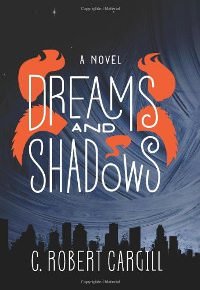
I almost passed over Dreams
and Shadows. The cover and the
title give the idea of a world of rainbows and lollipops darkened by
the glimmer of “Twinkle, Twinkle, Little Star”. Apparently the
British cover, distributed by a different publishing house, paints a
bit of a darker picture, but I didn't have that on hand at the time.
The only thing that drew me to take a chance on what seemed at first
glance to be a particularly uninspired children's novel was the
publisher's blurb, something that gave no promises but spoke of
hidden depths and dangers. The end result is one of my favorite
novels of 2013.
C.
Robert Cargill's Dreams and Shadows
tells the story of two boys linked by the fearless heroism and
arguable selfishness of one and the inhuman upbringing of the other
and the world that they both grew into. Generally speaking, it is
the world that draws you in, taking up the first half of the book,
and the plot that delivers in the second half. In the process of
doing this it becomes a strange creation; like Ewan (named for Ewan
MacGreggor after his parents watched Trainspotting
in the opening chapter) and Colby (not named for anything in
particular, although this name tends to remind me of cheese), an
amalgamation of a myriad of influences and cultures. Joining them
among the main cast are supernatural creates of Celtic, Germanic and
Arabic mythology, and along for the ride are fae of Christian and
Native American origin, among others.
It
is these influences that the first half of Dreams and
Shadows heaps upon us in
abundance (although we don't actually see fallen angels until the
second half). After a cringe-worthy opening that almost stretches
the perfect fairy tale romance too far (largely in making Ewan a baby
that is just so pleasant to have around that it tears willful
suspension of disbelief in two), the book takes a dark turn and
begins piling tragedy upon tragedy. The baby is replaced with a
changeling, the mother kills himself, the father is killed by an
underwater faerie in his attempts to drown the changeling. The story
of the tragedy that brought the changeling into existence is told,
and a further tragedy of an ancient djinn, who just so turns out to
have been irreparably cursed by somebody else's attempt to bring
happiness to the world. To say that this book is dark would be to
imply that the scenes that could be spun off into a slasher film on
their own are the least pleasant thing to be found here.
Throughout
all of this, each myth is explored, whether through the characters
themselves, exposition, or scholarly journals from the book's world
that are sampled where relevant. These journals introduce elements
of the world such as human speculation on whether a Leanan Sidhe is
truly evil or kills out of love, and how even a loving and friendly
faerie is likely to kill you for the sake of survival. It
is through these segments that we learn that the fae race entered
into a pact with Satan, for which its members routinely brainwash and
sacrifice human children for the sake of their own longevity.
All of this sets the tone for the abbreviated segment that becomes
the actual plot of the novel: the moment when the childhood life and
circumstances surrounding Ewan and Colby catches up with them, in the
form of the changeling who was sent to imitate Ewan and a faerie who
had a crush on him. Colby, who is in some ways the audience proxy
and is in other ways impossible for the audience to decipher, is his
only line of defense in a world that we have learned is only going to
make things hell for those who have been destined to be victims.
From there the story is a struggle to avoid terrible fate after
terrible fate.
If
I had to select one flaw within the pages of Dreams
and Shadows
to criticize, it is actually something that is associated with the
title: the word “dreamstuff”, which is used to describe the
energy that makes up everything supernatural about the world of the
novel. To be fair this is more than likely a remnant of the manner
in which it is introduced: as a physics article describing why the
universe has so much more energy than can be accounted for. It is
this physicist that coins the term “dreamstuff” in the book, and
it just fells so out of place in this passage that each subsequent
use of the word echoes that sentiment. If the “particle” was
given a slightly less whimsical name or were simply introduced in a
way in which this name made more sense (perhaps a sorcerer who first
developed the ability to control it through his dreams), it would
have been much easier to buy. In its current state, it feels as
though Cargill was merely at a loss of how to refer to magic without
alienating the mythologies included in the book, and chose an
inoffensive name out of a hat.
This
is a flaw I can overlook, however, as the name does little to effect
the overall story and mythology present. Dreams
and Shadows can
work equally well in the distinctive worlds of October
Daye
and Harry Potter
(though most efforts to combine them into a single canon would be
likely to raise more questions than answers), and is a thoroughly
entertaining book that dances across multiples moods and genres.
While it is on occasion frustrating to have to travel through a genre
you're not particularly in the mood for in order to get to one you
are (such as finding yourself in the middle of the aforementioned
“slasher” passage after picking up the book for a fantasy romp),
it's a minor annoyance and one that doesn't keep you guessing more
than is necessary to produce a diverse and interesting book. If
you're a fan of authors such as Brom or Seanan McGuire, Dreams
and Shadows
is a book that I would recommend picking up to slate your thirst for
fantasy.
Star Wars Book Review: Empire and Rebellion: Razor's Edge by Martha Wells
 Martha
Wells is a new author to the Star Wars
universe. It's about time for me to pull apart one of her books and
see what she's about. Razor's Edge
is a part of Empire and Rebellion,
a trilogy of novels set during the years of the first Star
Wars films. Well I say a
trilogy, I mean a trilogy kicked off by an “unrelated” Timothy
Zahn book to draw the Expanded Universe audience back to the era.
Well, I say a trilogy plus one, I mean an era that has enough comics
and novels to definitively prove that Han, Luke and Leia did not have
time to sleep between Death Stars. Well, I say that, I mean I like
that scene from “Army of Ghosts” a little too much. In any case,
Razor's Edge is set in
the general vicinity of Splinter of the Mind's Eye,
Allegiance, Choices
of One and Scoundrels,
though I think I can more definitively state that it is set later
than Scoundrels but
before Allegiance,
giving us a freelancer Han who has come to enjoy Leia's company, a
Leia who doesn't know what to think about Han and has come to trust
Luke, and a Luke who is still a green recruit with something to
prove.
It
is with this cast that we embark on the story of Razor's
Edge, in which Leia's diplomatic
mission – with Han Solo as escort – is attacked by both Imperials
and pirates, each of which seems to know a lot more about their
movements than they have any right to. It's not long from there
before Han and Leia become captives of the pirates, and Luke and
Chewbacca are dispatched to rescue them.
If
this sounds like a standard Star Wars
set-up, you're right, but it does deviate from the mold. Where from
one of the long-time Star Wars
authors, such as Timothy Zahn, Kevin J. Anderson, or Aaron Allston
this set up would include a story about Luke and Chewie's exploits up
until their rendezvous with Leia's group, in Razor's Edge
Well slices this side story off like one might trim the fat from the
side of a pork chop. I don't use that analogy by accident – while
a skilled chef might be able to use that fat to season the rest of
the meat, its loss does not greatly hurt the overall dish, and may
result in less unnecessary padding. So it is in Razor's
Edge, where Han and Leia have no
need for Luke to stumble into information about the enemy; they are
perfectly capable of finding it on their own.
Unfortunately,
without this side-plot, there's really no reason for Luke to be here.
Lando Calrissian would actually have been a better companion, if not
for the fact that Leia is not intended to meet him for several more
years. Luke shows up about halfway through the book, spends most of
the time aboard the Falcon,
and has one scene where he does something exciting but not
particularly memorable. I can't help but wonder if his inclusion at
all wasn't a bit of a marketing decision: Luke, Han, Leia and
Chewbacca in each book of the trilogy. Come to think of it, Han got
his own book in Scoundrels;
there's no reason this couldn't have been Leia's book without her
brother or future husband, with later books being dedicated to Chewie
and Luke. This would give each of the characters some breathing room
for once (I expect once I truly dig into the timeline of this era, I
will find that every day of this part of the war has been
meticulously plotted), plus the fact that I just gave an opening for
a Chewbacca book!
Okay, Chewie was in Scoundrels,
but isn't it about time for a book from Chewbacca's point of view
detailing some of the more important events in his life that we don't
normally see to be written? It's high time for the foreign friend no
one can understand to have his moment in the sunshine, but I digress.
Luke
isn't the only reason I think this book would have been better
without the added weight of Leia's traditional companions. She
spends much of this book with Han, which is largely a good thing.
Each has the opportunity to shine in their own type of story. The
problem is where they collide. Razor's Edge
is trapped between the era it takes place in and the era in which it
was written. That means that even though many readers would find any
setup for the relationship between Leia and Han tedious, it's
actually needed as it hasn't been explored at this stage yet. On top
of that, no matter how far it goes, both the author and the reader
are fully aware that the couple's first kiss will not happen for
several more years. The result of this odd positioning is that out
of nowhere there are a number of really awkward scenes of Han and
Leia each acting like borderline sex offenders, staring at one
another at really odd moments with no explanation, even a moment
where Leia yells at Han for being too sexy while he positions not to
get a painful cramp during an important security discussion. There's
really no way to win here, as some fans would feel cheated were this
mini-sub-plot left out completely, and it's clear that this is not
the focus of the book.
Another
moment where Han and Leia crashing into one another is a bit more
literal. Han has a very specific style of heroism about him most of
the time. He is an action-comedy character, the one who accidentally
saves the day, or does so intentionally in the most humiliating way
possible. Even when there's nothing funny about the act in and of
itself, it still tends to come at a particularly opportune moment,
such as Han's method of saving Luke from the Death Star.
Unfortunately, this clashes with Leia's subplot, which is one that
allows her to partake in all the action-adventure heroism that is
more frequently associated with male characters while not diminishing
her role as a woman and a diplomat. All of this can't help but come
across as a commentary, intentional or not, on the state of Science
Fiction in general, as the writing and portrayal of heroines is a
hotly contested issue across the board at the moment. None of the
things I've described are problems on their own, but when you add a
bumbling hero with a tendency to save people at the last minute to a
heroine who tends to put herself in harm's way and is also attractive
to him, it's very simple to send the wrong message by accident. It's
easy to see the steps that led up to this mistake, which makes it all
that much more understandable, but also all that much more
disappointing.
The
last minor complaint I have about Razor Edge
– and one that keeps it from being the 1970s-1990s era Star
Wars book it comes close to
being – is the humor. While I mention that Han is a bumbling
comedic hero, he is still written here as more of the somber veteran
than the noble clown. This book about piracy, slavery, death and
betrayal could really use some comic interludes to lighten the tone
at times, but the “lean cut” I described earlier keeps everything
focused on just how dreary and dark things are. There are a few
light-hearted or comedic moments, but for characters that lend
themselves so naturally to such moments, there are relatively few.
Where's Blue Max when you need him, eh?
Razor's Edge
is a good book, with some great action. This might be the first time
we really see Han and Leia – correct that, Leia and Han
– starring in an action novel of this sort, and while Han pulls out
all of the stops that you expect from someone who has done this way
too many times now, Leia really shines as she is put to the test in
every conceivable way. As somebody who owns and loves a wide variety
of Star Wars novels,
the negatives I pointed out didn't go a huge way toward dampening my
spirits while reading, but they did lead to some raised eyebrows and
hold me back from considering this to be one of my favorite Star
Wars novels of all time. If
Ewoks, Wes Janson and dreadnaughts shaped like a lightsaber are
essential to your Star Wars
experience this might be one to pass over – ditto if swinging
lightsabers and mind tricks are – but if you count Scoundrels,
Rogue Squadron and
Republic Commando as
your cup of tea, you won't regret picking up Razor's Edge.
Podcasts: Big Finish, Gojira and Pacific Rim!
That's right, it's time for another podcast roundup. As usual, there may be some NSFW language, so please use discretion.
First up is the first episode of Super Kaiju Podcast, where Mad Matt and I discuss Gojira with Matt Burkett of Monstrosities!
Also brand new is the latest episode of An Unearthly Podcast, with new co-star Eli and discussing our first Big Finish audio adventure: Destiny of the Doctors: Hunters of Earth, featuring the first Doctor. How does our First Doctor newbie find this story?
If anybody missed it, check out our podcast discussing the strengths and weaknesses of Pacific Rim (although it did eventually devolve into a group of fans enjoying discussing the movie)!
Win an iPad Mini
I have to link to the contest over at Laurie's Non-Paranormal Thoughts and Reviews for a chance to win an iPad Mini. I have a Mini myself and love the darn thing.
Good luck!
Insidious Chapter 2: Is it better to watch without the original?

In
2004, Director James Wan released Saw,
a film that used elements of the 1980s slasher craze in a unique way
and changed the entire direction of horror for years to come. Seven
years later, He released Insidious,
a haunting film similar to Poltergeist.
Insidious was a
visually muted film with a high creep factor and very positive
reaction from horror fans and critics. This led to a similar change
in thoughts about horror, inspiring such films as 2012's The
Woman in Black and 2013's The
Conjuring, also directed by
James Wan. The Conjuring
had a very similar style to Insidious
despite having a different writer and production studio, and many
viewers saw it as a spiritual successor to Insidious.
Fans looked forward to seeing Insidious Chapter 2
several months later, their expectations ramped up by the success of
the first film and The Conjuring.
Perhaps
it would have been better if The Conjuring
had held off – not for its own sake, but for the sake of Chapter
2. In fact, it would probably
be better if the audience had not seen the original. Insidious
Chapter 2 is not a terrible
movie, not by any means, but as a follow-up to Insidious
it falls terribly flat. Then again, anybody who watches Insidious
Chapter 2 without watching
Insidious is likely to
have little clue who any of the characters are, or why Josh doesn't
remember his past. So let's take a look: is Insidious
Chapter 2 better without any
knowledge of the original?
Let's
start with the visual style. To an even greater extent than The
Conjuring, Insidious
had a very muted color scheme. In fact, there were two distinct
colors that were not desaturated: blue, which represented Josh's son
Dalton, and red, which represented the evil spirits that were
haunting him. Here, the entire film is in full color with full
saturation. On top of this, red is in virtually every scene.
Knowing Insidious, I
found this incredibly distracting. This might be because there are a
pair of spirits that are essentially haunting every scene, but still,
there is such a thing as too much of an iconic color. We get it,
Bruce Willis is a ghost; we saw that at the end of the first film and
new viewers saw it at the beginning of this one. At times, there is
so much red lighting that I half expected Freddy Krueger to pop out
from around the corner with a one-liner.
Which
brings us to the script itself. The Bride in Black (which appeared
in the original film but was apparently not
the Darth Maul spirit) was actually this film's version of Angela
from Sleepaway Camp, who eventually reaches the point where he is
rampaging through the house with a bat and the audience expects him
to break through a door and yell “here's Johnny!” In other words,
the story is entirely unnecessary and reinforces that in every way.
There is not enough substance here to fill a film, and it feels as
though Leigh Whannell was desperate to have enough material to fill
the film, which led to several scenes that made absolutely no sense
and had absolutely no payoff. Would this film have been hurt in any
way if Josh hadn't spontaneously developed Donnie Darko-like time
travel capabilities? The characters are paler versions of their
original selves, with little actual character – even the spirit
that possesses Josh's body seems rather lost at times. Ultimately,
the connections between this film and the previous are rather
unnecessary. I mentioned earlier that the original film explains why
Josh has no memory of his past, but even knowing that the memories
were hypnotized out of him does not explain why they had to time
travel in order to access those memories. Wouldn't another session
of hypnosis been equally effective, and made a lot more sense?
How
about the scares? There are definitely some scares in the film,
which is the main reason why I think this might be a good film if it
could get some distance from the rest of James Wan's films. The
first appearance of Mother Mortis – or rather, the first group of
scenes leading up to her actual appearance – carry some genuine
suspense and fright. Several of the other scenes featuring her
without her son are effective as well. Unfortunately, these scenes
aren't enough to hold a candle to what we saw in the first film, and
there is just not enough of it amidst some of the confused writing in
which the script stumbles about, uncertain of whether or not the
audience is fully aware that there is an enemy in their midst.
Somehow, all of the tension and possibility for scares was cut out of
the possession plotline, which is extremely unfortunate when you
consider that plot is entirely the reason why this film got made.
In
the end, there are things to recommend Insidious Chapter 2
for, but it's hard to find an audience to recommend them to. I
wouldn't watch this after the first, nor would I watch the first
after this, but if for some reason you never plan to watch the first,
you might enjoy this as its own movie. Still, it's very hard to
recommend this with it standing next to The Conjuring
in theatres and with Insidious
so fresh in the public's memory. If anything, Chapter 2
feels like a sequel produced in the late '90s for a film from the
'70s, which is disappointing when you consider that the writer,
director and stars returned (even if Ty Simpkins barely appeared due
to aging two years). The bottom line is watch this film when it
comes out on Netflix, and buy a ticket to The Conjuring.
P.S. Check the epilogue for
more of Jimmy's dolls.
Subscribe to:
Posts (Atom)