


An Unearthly Podcast: The Time Machine
We finally reach the end of Destiny of the Doctor! Does it meet expectations?
Red Ribbon Reviewers

An Unearthly Podcast: Death's Deal
The Unearthly Podcast crew continues our look at Big Finish's Destiny of the Doctor
series. Can Big Finish do my favorite Doctor justice?
Some NSFW language may occur.
An Unearthly Podcast: Night of the Whisper
The Unearthly Podcast crew continues our look at Big Finish's Destiny of the Doctor
series. The Ninth Doctor finally returns, with two of his most popular companions!
Some NSFW language may occur.
An Unearthly Podcast: Enemy Aliens
The Unearthly Podcast crew continues our look at Big Finish's Destiny of the Doctor
series. How is Destiny going to be faithful to the 8th Doctor's season? Perhaps it will be a movie on Fox...
Some NSFW language may occur.
An Unearthly Podcast: Light at the End feat. Night of the Doctor
We take a break from Destiny of the Doctor to celebrate the 50th anniversary of Doctor Who, with all eight Doctors of the classic era. But first, the TV series refuses to be outdone, finally giving the classic era closure of its own!
Some NSFW language may occur.
An Unearthly Podcast: Shockwave
The Unearthly Podcast crew continues our look at Big Finish's Destiny of the Doctor
series. My favorite classic Doctor and companion are here!
Some NSFW language may occur.
Book Catharsis: An Artificial Night by Seanan McGuire
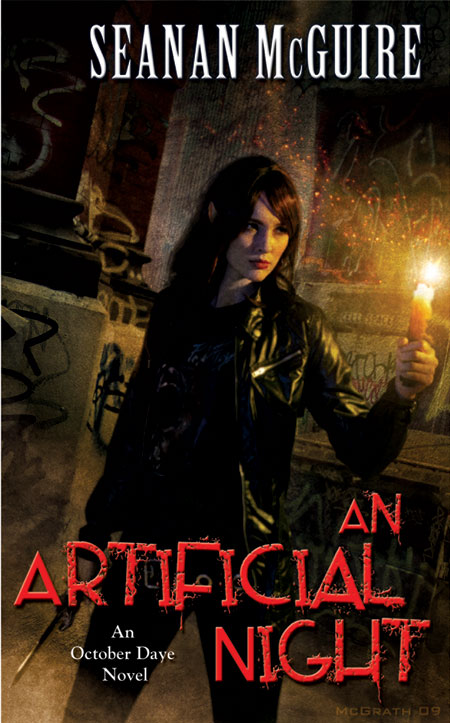
It’s difficult to start off a review of An Artificial Night, because it was nothing that I expected, and everything that I needed. An Artificial Night is the third novel in the October Daye series by Seanan McGuire. The first book, Rosemary and Rue, introduces the universe and the character, while taking the readers on an insane ride and a great mystery. The second book, A Local Habitation, continues the story, advancing the characters and giving a somewhat less compelling mystery. I expected An Artificial Night to be somewhere along the lines of Rosemary and Rue, rebounding from what I’ve heard described as the weakest book in the series to bring on a long-term series. Instead, what I got was pure catharsis.
There are those times in your life when you’ve got to be a big shot, don’t you? You’ve got to open up your mouth. Toby had to be a big shot, didn’t she, and her friends were so knocked out. She had to have the last laugh that night; she knew what everything’s about. She had to have a white hot spotlight. She had to be a big shot last night.
I’m fairly certain that Billy Joel meant that with a negative connotation, while this is what I love about An Artificial Night. Everybody sometimes needs to kick a bully in the teeth and punch him in the kidneys, and that’s what An Artificial Night is about. It’s not a mystery. There are questions, but that’s not the point of the story. The fact that there are more sequels to this implies that October survives, so I hope I’m not spoiling much when I say that Toby accomplishes just that. The question isn’t who is the bad guy or whether Toby is going to beat him, it’s what the hell Toby is going to do and how she’s going to get out of this.
Every moment was glorious. Toby is already an extremely cathartic character. She is a girl whose mixed blood causes her to be initially seen as less than nothing to those that she interacts with, yet this never causes her to still her tongue or her hand. She earned her way to knighthood, it was damned hard, and there is no way she’s going to let anyone talk down to her. Just to add to this, An Artificial Night introduces a conflict that is essentially that of a satyr reaching up and punching Zeus in the nose for being a dick - and then doing it again because the message didn’t stick.
An Artificial Night is really one of those stories that should be experienced, rather than explained, but even more than that it should really be experienced when you’re in a foul mood and could use something to bring you back. Anybody who has ever been bullied, or been out of reach and unable to stop a bully, or witnessed a bully, or known of a bully, can’t help but to love Toby as she goes above and beyond and says “I don’t care if I am an ant standing up to an anteater, this ends here” (that’s not a quote, unfortunately).
I would gladly say that this story stands on its own, but it is also a part of the mythos, and should still be regarded as such. I don’t know enough about the series yet to say that it must be read in order, but it certainly ought to be read after A Local Habitation, which in turn is best read by somebody who has already read Rosemary and Rue. This is an expanding universe, one that is taking on new characters and mythical elements with each story, so this is to be expected. Ultimately, this is a double-edged sword: while I am glad that it appeals to me even more as a sequel to books that I’ve already enjoyed, I am disheartened to think that there might be circumstances in which it is out of place for someone picking it up to read it. Maybe that’s just another reason for somebody who’s never read Rosemary and Rue to pick it up: when you never know when you’re just going to have to read An Artificial Night and need some background for it.
An Unearthly Podcast: Trouble in Paradise
The Unearthly Podcast crew continues our look at Big Finish's Destiny of the Doctor series. Will a series known for being faithful to the era it's imitating faithfully imitate an era known for being the downfall of the classic series?
Some NSFW language may occur.
Book Review: Speaker for the Dead by Orson Scott Card
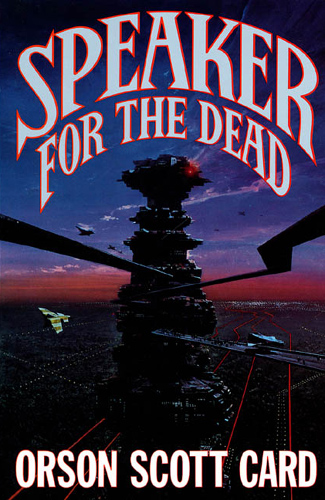
Speaker for the Dead was published by Tor Books in March of 1986. It had one prequel, the novel adaptation of Ender’s Game, originally published as an independent novella. All three were written by Orson Scott Card, and by the time the two novels were written the third, Xenocide, was on the way. Speaker for the Dead won the Nebula Award in 1986 and the Hugo Award in 1987 and starred Ender Wiggin, the star of Ender’s Game.
I’d find it refreshing to continue in this vein, and simply speak the truth about the novel, but I’m either not talented enough to do this book justice in that manner, or it’s simply not the way for me to go about this. That might be true for yet another reason: the Ender series isn’t dead.
Speaker for the Dead was conceived independently of Ender’s Game, and it shows, because the two novels are completely different. Ender Wiggin is the connecting factor, and he’s a big one; as literally both the head and the heart of the novels, his mind and methods are an important piece of why both novels succeed. Ender Wiggin is, at the core of his person, a genius, from the same ilk that spawned a man who hid his identity until after he had taken the world. Other than the fact that both Ender and his sister have continued publishing works under their assumed identities for a thousand years in real-time (accounting for the effects of thousands of light-years of travel at relativistic speeds), that’s stopped being relevant long ago. What’s important is that he’s assertive and compassionate, with all of the people skills learned by a lifetime of officer training condensed into a single childhood, and all of the empathy that made him worthy of all of that training. Add that to the fact that he’s become close friends with an AI that acts as this universe’s version of the Force, and Ender Wiggin may just be able to solve any problem that’s thrown at him.
But Ender’s a hero, and he’s survived his trials. Of course we root for him, but what’s truly powerful about this writing is the people who were never intended to be heroes. When someone like Ender Wiggin or Luke Skywalker, or Odysseus goes through trials, it’s okay. We grieve with them, we emphasize them, but ultimately as an audience, we’re cheering for them. Because we know that they have a destiny, that all of this pain is going to serve a purpose, and they’re being prepared to save somebody. But when regular people, with no special training and no special future, go through the same trials and have nothing in return for it, that’s when it really hurts.
That’s the thing about Fiction, really. People who decry Fiction for being too dark and people who hate escapism are both missing the point. Fiction allows a reader to experience things, powerful things, without facing the consequences themselves. It’s about emotional highs and lows as much as it’s about anything else. It allows you to experience incredible pain and sadness and anger and relief and acceptance all in a short time, without requiring you to live through the physical or emotional abuse of a lifetime first. It’s the rush of a race without the risk of impending crash, but in the hands of a dedicated writer, it becomes so much more than that too, because you’re meeting real people, and helping them through their trials just by bearing witness. And that, more than anything else, is what Speaker for the Dead is about. Feeling, without being devastated. Speculating without the consequences of acting on mistakes.
Not that everything is quite so straight-forward as the power of Fiction. In order to make this a true world, a real world with people living in it, Card by necessity made this a more complicated book. After all, a military organization- any military organization- is simpler than a town with a belief structure. That’s a large part of the function of the military: to keep everything in the social and power structure as simple and easy to follow in order to eliminate distractions. On Lusitania you have three competing power structures: the political, the religious, and the intellectual. In order to subvert the trope of characters from other worlds always having short, simple to pronounce names, the colonials speak Portuguese, each having long, over-blown names in addition to a shorter nickname for the audience.
The Catholic Church is a major player in this novel, which might be a problem for some readers. As somebody who both disagrees with certain aspects of the church in very strong ways and somebody who came into the novel with certain notions about how I expected the author to handle religion, I struggled with certain scenes. Early on, the portrayal of the church seemed to alternate between it being a villainous organization and the right way to live. Ultimately, though, this book doesn’t come out with a lot to definitively say about the church. The Catholic religion functions exactly as it does, one individual is shown to be pompous and overbearing in the beginning and to have a more open mind toward the end, and the church is portrayed as having the exact amount of power that it would have on a monotheologic colony twenty light years from the nearest other human settlement. Much like a speaking for the dead, this novel portrays the good along with the bad as part of a more complete truth, and doesn’t cram any belief or intent down the reader’s throat.
Speaker for the Dead is a story about the hard knocks of life. Through the veneer of Science Fiction and the suspense of interspecies relations, Orson Scott Card writes about dealing with terrible things, and about how good intentions lead several families through misery that might take several generations to work itself out. It’s also about more mundane miseries, such as the pain you feel when somebody shows affection that you’re used to seeing reserved for yourself to someone else in your stead. This is balanced out by the xenobiology and anthropology featured in the novel, which makes for some fascinating philosophical debates and great mysteries for the scientific-minded to work out, making this a great book for anybody who desires full immersion in a novel that pulls very few punches and demands you to read with both your mind, and your soul.
An Unearthly Podcast: Smoke and Mirrors
The Unearthly Podcast crew continues our look at Big Finish's Destiny of the Doctor series, this time with an unexpected guest that every Doctor Who fan will be familiar with!
Some NSFW language may occur.
Book Review: Ender's Game by Orson Scott Card

Orson Scott Card’s Ender’s Game might well be the most beloved prequel in all of literature. Not all versions of the story are the prequel, and it wasn’t released that way, but if not for Speaker of the Dead, the novel form of Ender’s Game that so many of us grew up with would never have come to be.
Ender’s Game tells the story of the Wiggins siblings, Andrew (nicknamed “Ender”), Peter and Valentine. The story’s not told from Peter’s perspective- it would be difficult to keep the “innocence under duress” tone of the novel if it featured viewpoints of a true sociopath- but there are a good deal of passages of Valentine and Peter working together or at odds. This is told largely independently of the story of their brother, the titular Ender, but Valentine plays a key role in Ender’s development.
An ironic side effect of reading this book with my particular tastes is the psuedo-incestual vibe this book starts to give off. That might be slightly disturbing if you don’t know what I’m talking about from having read my past reviews, but that’s okay, because that just makes it more funny. What’s ironic is that picturing a devout religious individual with certain very traditional values regarding religion writing something with an unintentional incest vibe is just funny to me. And of course, what’s “psuedo” is the fact that Ender probably hasn’t gone through puberty by the time the book ends, and it’s only his precocious nature that allows an older reader to see his tendencies as anything other than child-like innocence.
Now that I’ve made everybody thoroughly uncomfortable, what is it that elevates this book to such a status, despite the fact that the entirely series has an obvious “written during the heart of the Cold War” vibe? Maybe it’s the way a “children can save the world” story is told in a way that adults can still find believable and interesting. It could be the way the aspects of the Hero’s Journey are exaggerated to their most powerful extent, with all of the emotion behind it of a bare child. Maybe it’s the way a good person could do ethically questionable things in a completely un-questionably ethical way.
All of these elements are present in Ender’s Game, not to mention a twist at the end that makes me hesitant to even discuss the plot for fear of first-time readers seeing this. There’s a host of characters, with the biggest flaw of the book being that few of the characters are given enough personality to be memorable down the line. You want to learn more about them, but the story is about Ender. One of the more mysterious players, an even younger boy nicknamed “Bean”, gets his own series of novels, and my only hope is that some of these side characters get their real moments to shine (and aren’t revealed to have been burnt up in their childhood) in these books.
Ender’s Game is a book that any Science Fiction fan should read- particularly young ones who can handle death in fiction but are still learning their way around the genre. It’s not hard Sci-Fi, not because it’s Fantasy, but because the writer felt that the book should be easy for everybody to understand. I personally wouldn’t have minded an extra 1% or so to harden the science, but I can definitely agree that it wouldn’t have been as accessible to me at twelve years old if that were the case. And that’s the point- the accessibility of this book is what catapulted Ender to the forefront of the young adult genre. But it’s not the only reason to read it.
And, for the record, I’m not qualified to comment on Card’s life outside of his fiction work, but if you feel you are, this book is crazy easy to find used, so don’t let politics get in the way of enjoying and learning from this piece.
An Unearthly Podcast: The Day of the Doctor
For those who don't follow us via other channels, on November 24th, the Unearthly Podcast crew discussed the Doctor Who 50th anniversary special: The Day of the Doctor.
My Thoughts About Ender's Game: How Much Thought Went Into It?

I really would have liked a second
opportunity to watch Ender's Game
before writing about it. In all honesty, I can't consider this a
review. I'm of mixed mind on a lot of things, which is why even this
took so long to write. That, and the fact that November kept my nose
to the grindstone, as it were.
What
is Ender's Game, then?
Well, for one, it's a film that a lot of people were really
interested in seeing. I imagine many schoolchildren were first
introduced to Science Fiction by Orson Scott Card. Now, years later
for me and decades later for this story, it's on film. Ender's
Game was a very cerebral novel,
largely taking place in Ender's head, gauging his reactions as he
transformed from a boy with potential to a leader with no choice to
do anything but.
Writer/Director Gavin Hood's
biggest project prior to this was X-Men Origins: Wolverine,
a film that, to put it lightly, was not well received. How did this
influence his approach to Ender's Game?
Well, it seems that Hood was inspired to transform Ender's
Game into...a music video.
No,
this isn't a movie in the manner of Moonwalker
or Heavy Metal. It
wears the facade of a regular movie. But it was written like the
skit segments of a music video. It had the same feeling of
compression, the same depth of plot and character, as a music video.
It had the same strange, semi-symbolic-but-mostly-just-surreal
imagery as a music video. And it had just the sort of long,
drawn-out sequences of walking down a corridor as strange things
change for no reason that made me expect David Bowie to step on
screen and start twirling his balls...ball. Whatever.
It
is clear that Gavin Hood understood a lot of the plot elements that
made Ender's Game
work. It is just as clear that he either didn't understand why
they worked, or he didn't understand how to adapt it into a cohesive
movie that still worked. Instead, we get a jumble of plot points
thrown at us like a game of plot-point dodgeball, with all of the
time that made them work skipped over. We get lingering scenes of
the highest paid actor in Hollywood earning his paycheck by talking
about what Ender should be doing, which results in his entire
schooling seeming to take less than a week, rather than the years of
sweat and focus that honed the story in the novel. In Card's
original, everything went by quickly, but it slowed down enough to
make a logical progression. Ender learned by observing. In
Gavin Hood's Ender's Game,
Ender learns by simply being a genius. Every tactic that he uses, he
knows without seeing anything to allow him to learn. This adds to
the fact that he is impetuous, blunt and unable to take a hint.
There
are things, however, that make me wonder how much of this is really
Hood's fault, and how much of it is the result of attempting to make
a story like this in the Hollywood atmosphere of flash and money. I
already mentioned one rather obvious example. Here's another.
In
Ender's Game, there is
one female character of note. I'm not talking about Valentine; she's
not a character. She's almost a character, and I would say that by
the time Speaker for the Dead
comes around, she is one, but here, she largely exists as a motivator
for Ender. No, I am speaking about Petra Arkanian, the girl who
shows Ender the ins and outs of Battle School (that's not meant as a
euphamism, and I'll explain why not in a moment) and, later, becomes
the lieutenant that Ender leans on so much that she is the first to
have a nervous breakdown.
As
for the point that I said I would explain, one point that is
simultaneously brilliant and frustrating about Ender's Game
is the fact that the characters are just young enough to make a
sexual relationship all but impossible. Sure, in the right
environment, romance and physical love can happen between pre-teens,
but when the idea isn't presented, it's not very likely.
Particularly in a distraction-rich environment like Battle School.
This helps to tone down the potentially incestuous undertones of the
story, as well as preventing Petra from growing into a love interest,
as much as readers interested in giving the characters a happy ending
(or even a respite from Battle School) might wish her to. Still,
this allowed Petra to be just “one of the boys”, if one of the
smartest and funniest among them, without her sex being used as a
means to judge her.
All
of which is completely antithetical to the mainstream film-making
mentality. Ten and twelve year olds aren't used for a role of this
complexity. And films like this don't happen without some sort of
love interest. So Petra's role is expanded. She's added in to extra
scenes, and has less of her scenes cut than anybody else in the
story. In fact, she is the only member of Ender's team that makes
sense to share a bond with him in the context of the story; the only
one that we really see share any hardships with him, other than his
sister. She's then given awkward hand-holding scenes and alone time
with him, just enough for the trailers to show a love interest
without explicitly denying everything that she was in the original
story. The latter issue is resolved when, instead of being a trusted
commander that Ender learns too late not to use as a crutch, she
becomes an object to be protected. Rather than controlling large
swaths of the battlefield, the only woman in the main cast becomes
someone who must sit back and let the men protect her until it is
time for her to hit a button.
The
visuals are where the budget of this film was really placed and,
while they don't really fit with the story that needs to be told,
they are impressive. While it's impossible to forget that you are
watching a trailer, or a music video, or both at times, it's still
hard to tear your eyes from the screen. Ender's Game
was made for IMAX screens, most likely a way to justify making a
Sci-Fi film as different from the standard Hero's Journey model as
Ender's Game is.
Ultimately,
I need to watch this movie again when it comes out on Netflix. I
have a lot of complaints, but the end result was still mostly
entertaining to watch. There are a few key scenes that I need to
look for, and some other things that I need to look at, before I can
make a final decision about this movie. As the very least, it is a
fair companion to the book. I could see clips of this movie being
played while summarizing the book, or even an edited version being
used as a visual novel. No matter what the case, though, it's a far
cry from the strength of the original story.
Subscribe to:
Posts (Atom)