
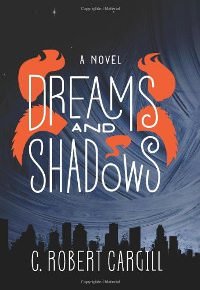
I almost passed over Dreams
and Shadows. The cover and the
title give the idea of a world of rainbows and lollipops darkened by
the glimmer of “Twinkle, Twinkle, Little Star”. Apparently the
British cover, distributed by a different publishing house, paints a
bit of a darker picture, but I didn't have that on hand at the time.
The only thing that drew me to take a chance on what seemed at first
glance to be a particularly uninspired children's novel was the
publisher's blurb, something that gave no promises but spoke of
hidden depths and dangers. The end result is one of my favorite
novels of 2013.
C.
Robert Cargill's Dreams and Shadows
tells the story of two boys linked by the fearless heroism and
arguable selfishness of one and the inhuman upbringing of the other
and the world that they both grew into. Generally speaking, it is
the world that draws you in, taking up the first half of the book,
and the plot that delivers in the second half. In the process of
doing this it becomes a strange creation; like Ewan (named for Ewan
MacGreggor after his parents watched Trainspotting
in the opening chapter) and Colby (not named for anything in
particular, although this name tends to remind me of cheese), an
amalgamation of a myriad of influences and cultures. Joining them
among the main cast are supernatural creates of Celtic, Germanic and
Arabic mythology, and along for the ride are fae of Christian and
Native American origin, among others.
It
is these influences that the first half of Dreams and
Shadows heaps upon us in
abundance (although we don't actually see fallen angels until the
second half). After a cringe-worthy opening that almost stretches
the perfect fairy tale romance too far (largely in making Ewan a baby
that is just so pleasant to have around that it tears willful
suspension of disbelief in two), the book takes a dark turn and
begins piling tragedy upon tragedy. The baby is replaced with a
changeling, the mother kills himself, the father is killed by an
underwater faerie in his attempts to drown the changeling. The story
of the tragedy that brought the changeling into existence is told,
and a further tragedy of an ancient djinn, who just so turns out to
have been irreparably cursed by somebody else's attempt to bring
happiness to the world. To say that this book is dark would be to
imply that the scenes that could be spun off into a slasher film on
their own are the least pleasant thing to be found here.
Throughout
all of this, each myth is explored, whether through the characters
themselves, exposition, or scholarly journals from the book's world
that are sampled where relevant. These journals introduce elements
of the world such as human speculation on whether a Leanan Sidhe is
truly evil or kills out of love, and how even a loving and friendly
faerie is likely to kill you for the sake of survival. It
is through these segments that we learn that the fae race entered
into a pact with Satan, for which its members routinely brainwash and
sacrifice human children for the sake of their own longevity.
All of this sets the tone for the abbreviated segment that becomes
the actual plot of the novel: the moment when the childhood life and
circumstances surrounding Ewan and Colby catches up with them, in the
form of the changeling who was sent to imitate Ewan and a faerie who
had a crush on him. Colby, who is in some ways the audience proxy
and is in other ways impossible for the audience to decipher, is his
only line of defense in a world that we have learned is only going to
make things hell for those who have been destined to be victims.
From there the story is a struggle to avoid terrible fate after
terrible fate.
If
I had to select one flaw within the pages of Dreams
and Shadows
to criticize, it is actually something that is associated with the
title: the word “dreamstuff”, which is used to describe the
energy that makes up everything supernatural about the world of the
novel. To be fair this is more than likely a remnant of the manner
in which it is introduced: as a physics article describing why the
universe has so much more energy than can be accounted for. It is
this physicist that coins the term “dreamstuff” in the book, and
it just fells so out of place in this passage that each subsequent
use of the word echoes that sentiment. If the “particle” was
given a slightly less whimsical name or were simply introduced in a
way in which this name made more sense (perhaps a sorcerer who first
developed the ability to control it through his dreams), it would
have been much easier to buy. In its current state, it feels as
though Cargill was merely at a loss of how to refer to magic without
alienating the mythologies included in the book, and chose an
inoffensive name out of a hat.
This
is a flaw I can overlook, however, as the name does little to effect
the overall story and mythology present. Dreams
and Shadows can
work equally well in the distinctive worlds of October
Daye
and Harry Potter
(though most efforts to combine them into a single canon would be
likely to raise more questions than answers), and is a thoroughly
entertaining book that dances across multiples moods and genres.
While it is on occasion frustrating to have to travel through a genre
you're not particularly in the mood for in order to get to one you
are (such as finding yourself in the middle of the aforementioned
“slasher” passage after picking up the book for a fantasy romp),
it's a minor annoyance and one that doesn't keep you guessing more
than is necessary to produce a diverse and interesting book. If
you're a fan of authors such as Brom or Seanan McGuire, Dreams
and Shadows
is a book that I would recommend picking up to slate your thirst for
fantasy.


0 comments:
Post a Comment